Tutorial
Dry-run
In order to check your config file before actually processing it, the
--dry-run option is useful.
./MuSTA.R \
  --dry-run \
  --input test/input.csv \
  --gtf test/reference/test.ref.gtf \
  --genome test/reference/chr16_18_head.fa
This command returns 4 types of information.
- Valid arguments
- Session information
- Paths to intermediate files to be generated.
- The generated workflow based on the options
In addition, you can find ‘plan_pre_run.pdf’ in your working directory, which visualizes the generated workflow.
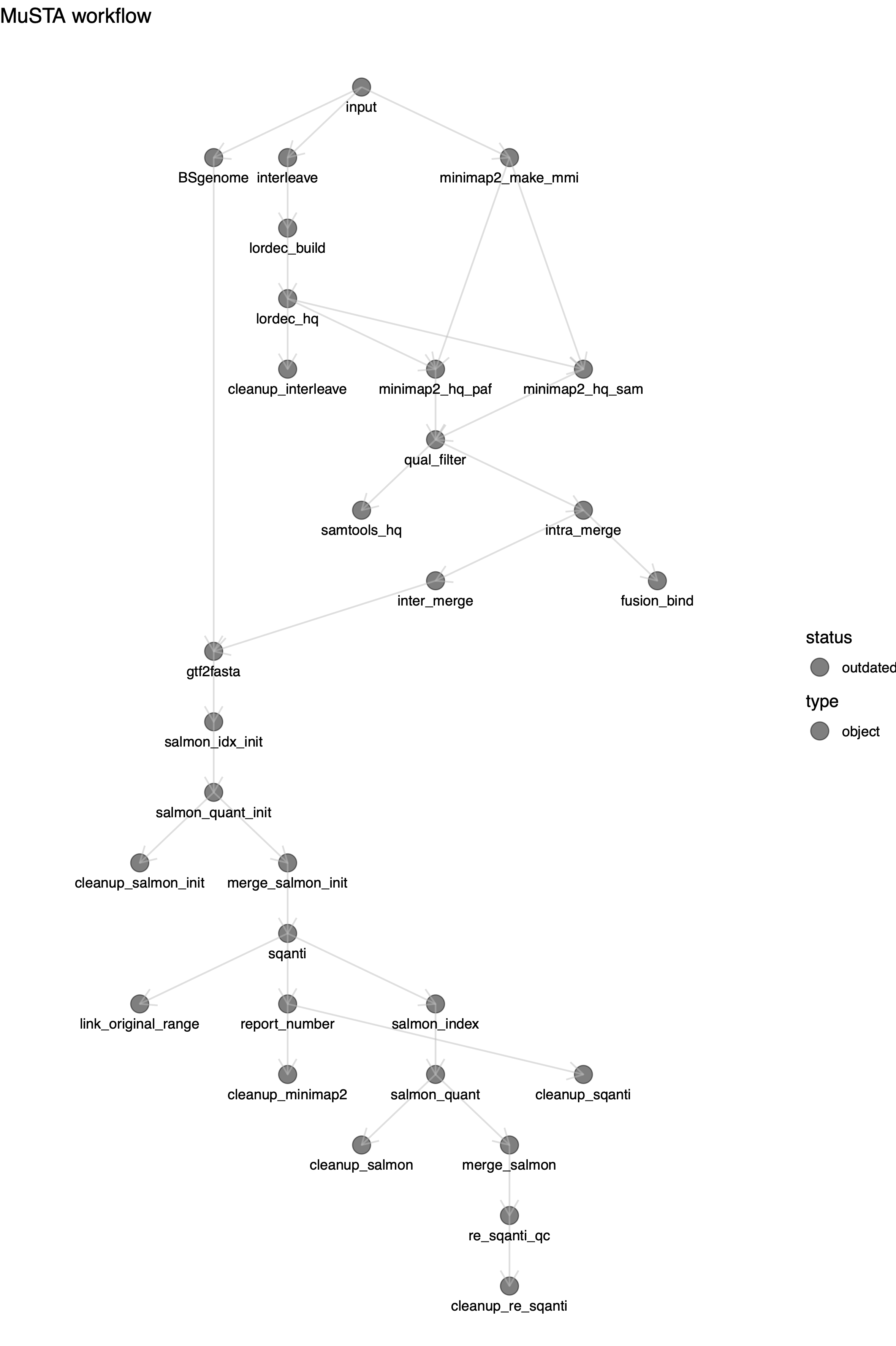 plan_pre_run
Test run
You can apply MuSTA to a test data by
./MuSTA.R \
  --input test/input.csv \
  --gtf test/reference/test.ref.gtf \
  --genome test/reference/chr16_18_head.fa \
  --output test/test_output
This command creates a directory named ‘test/test_output’ containing 8 sub-directories
output:
    result
    report
    script
    log
    sample
    merge
    fusion
    genome
By checking ‘report/plan_post_run.pdf’, you can find that all procedures have been done.
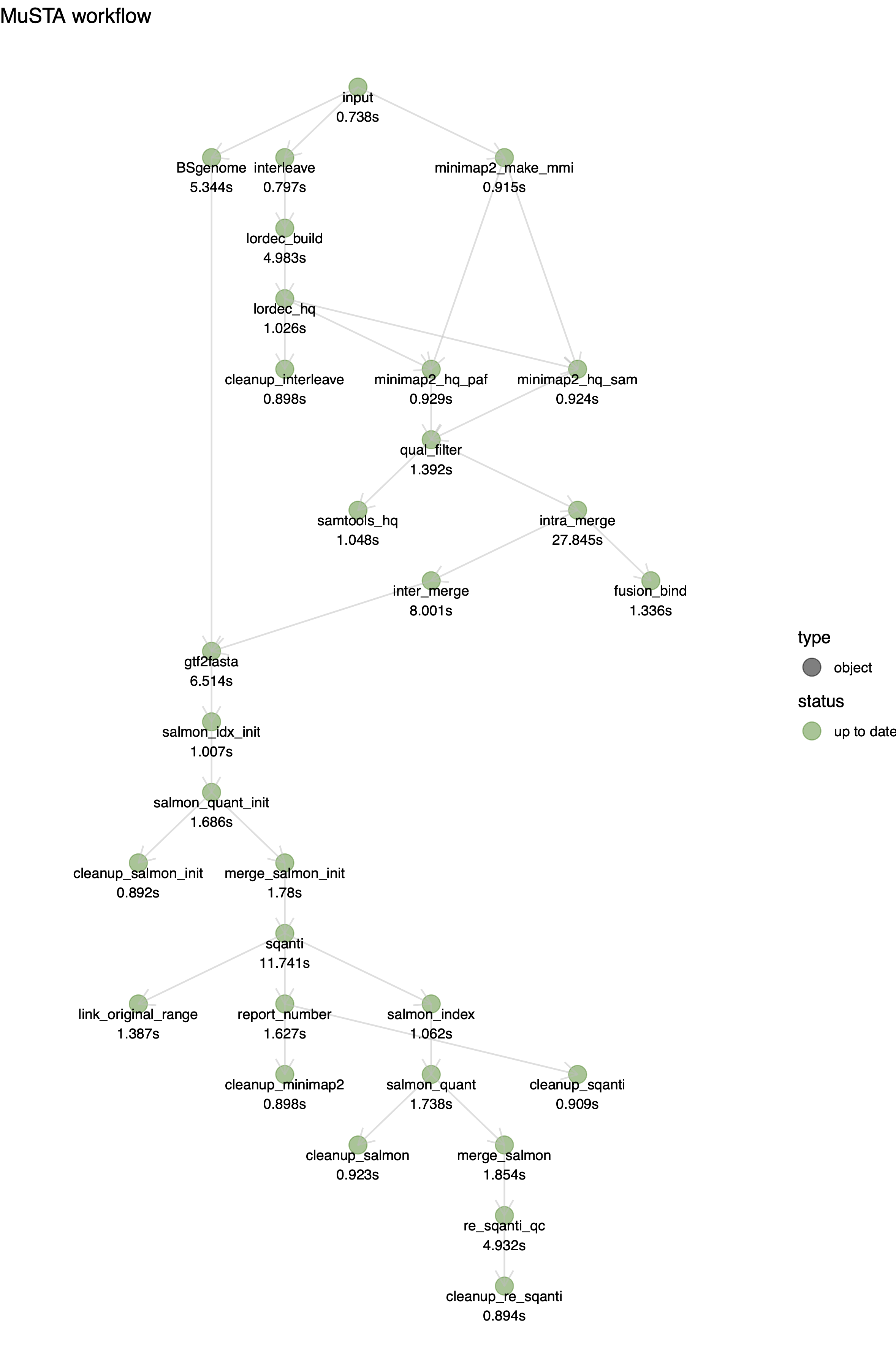 plan_post_run
All of the important outputs can be found in the ‘result’ directory. The
main outputs have the prefix supplied by the --prefix option (in this
tutorial, the prefix is ‘musta’).
# The assembled transcriptome
## fasta
print(Biostrings::readDNAStringSet("test/test_output/result/musta.fa"))
#>   A DNAStringSet instance of length 8
#>     width seq                                          names
#> [1]   571 TGGAGGAAAGATGAGTGAGAG...GAAAACAGGGGAATCCCGAA PB.1.1
#> [2]  1652 CTTGCCGTCAGCCTTTTCTTT...AAGCACACTGTTGGTTTCTG PB.1.2
#> [3]   248 CCTTTGGTTCTGCCATTGCTG...GAAAACAGGGGAATCCCGAA PB.1.3
#> [4]   920 CTTAGGGAACAAGCATTAAAC...TGAATTGATGTTTTCCTGCT PB.2.1
#> [5]   699 AGGGGCGCGCAGCGCCGGCGC...TTTTTGGAGATTTCTGTCTT PB.2.2
#> [6]  1800 AACTGAGGTCACCAGTCCCCA...GAGTGTCAGTTTAATGCTTG PB.3.1
#> [7]   567 GTAACACACAATACAGACTTC...ATATAAAAGATAGAAATCTC PB.4.1
#> [8]   207 AGAGCCTAGAAAATATCACCT...AAATACGCAAAATAAAGAGC PB.4.2
## gtf
knitr::kable(as.data.frame(rtracklayer::import("test/test_output/result/musta.gtf")))
| seqnames | start | end | width | strand | source | type | score | phase | gene_id | transcript_id |
|---|---|---|---|---|---|---|---|---|---|---|
| 18 | 11200 | 12999 | 1800 | - | NA | exon | NA | NA | PB.3 | PB.3.1 |
| 16 | 11861 | 11908 | 48 | + | NA | exon | NA | NA | PB.1 | PB.1.1 |
| 16 | 12294 | 12378 | 85 | + | NA | exon | NA | NA | PB.1 | PB.1.1 |
| 16 | 12663 | 12733 | 71 | + | NA | exon | NA | NA | PB.1 | PB.1.1 |
| 16 | 12906 | 13073 | 168 | + | NA | exon | NA | NA | PB.1 | PB.1.1 |
| 16 | 13153 | 13351 | 199 | + | NA | exon | NA | NA | PB.1 | PB.1.1 |
| 16 | 11555 | 11908 | 354 | + | NA | exon | NA | NA | PB.1 | PB.1.2 |
| 16 | 12294 | 12402 | 109 | + | NA | exon | NA | NA | PB.1 | PB.1.2 |
| 16 | 12902 | 14090 | 1189 | + | NA | exon | NA | NA | PB.1 | PB.1.2 |
| 16 | 13025 | 13073 | 49 | + | NA | exon | NA | NA | PB.1 | PB.1.3 |
| 16 | 13153 | 13351 | 199 | + | NA | exon | NA | NA | PB.1 | PB.1.3 |
| 18 | 14195 | 14653 | 459 | - | NA | exon | NA | NA | PB.4 | PB.4.1 |
| 18 | 14851 | 14958 | 108 | - | NA | exon | NA | NA | PB.4 | PB.4.1 |
| 18 | 14490 | 14653 | 164 | - | NA | exon | NA | NA | PB.4 | PB.4.2 |
| 18 | 16856 | 16898 | 43 | - | NA | exon | NA | NA | PB.4 | PB.4.2 |
| 18 | 11191 | 11595 | 405 | + | NA | exon | NA | NA | PB.2 | PB.2.1 |
| 18 | 13152 | 13354 | 203 | + | NA | exon | NA | NA | PB.2 | PB.2.1 |
| 18 | 15617 | 15928 | 312 | + | NA | exon | NA | NA | PB.2 | PB.2.1 |
| 18 | 11103 | 11595 | 493 | + | NA | exon | NA | NA | PB.2 | PB.2.2 |
| 18 | 15617 | 15822 | 206 | + | NA | exon | NA | NA | PB.2 | PB.2.2 |
## PBcount: the number of uniquely associated full-length non-chimeric (FLNC) reads
knitr::kable(readr::read_tsv("test/test_output/result/musta.pbcount.txt", col_types = readr::cols(.default = readr::col_character())))
| gene_id | transcript_id | sample1 | sample2 | sample3 | sample4 |
|---|---|---|---|---|---|
| PB.1 | PB.1.1 | 1 | 0 | 0 | 0 |
| PB.1 | PB.1.2 | 2 | 2 | 4 | 2 |
| PB.1 | PB.1.3 | 0 | 0 | 0 | 1 |
| PB.2 | PB.2.1 | 3 | 2 | 0 | 3 |
| PB.2 | PB.2.2 | 1 | 0 | 2 | 0 |
| PB.3 | PB.3.1 | 3 | 4 | 4 | 4 |
| PB.4 | PB.4.1 | 1 | 3 | 0 | 0 |
| PB.4 | PB.4.2 | 1 | 0 | 0 | 0 |
## (Short-read) expression: Transcript-per-Million (TPM) calclated by salmon
knitr::kable(read.table("test/test_output/result/musta.salmon.tpm.txt", header = TRUE, sep = "\t"))
| sample1 | sample2 | sample3 | sample4 | |
|---|---|---|---|---|
| PB.1.1 | 1.511232e+04 | 44382.6210 | 88062.37451 | 1.472174e+04 |
| PB.1.2 | 3.120952e+01 | 127.4420 | 21.76253 | 1.540468e+01 |
| PB.1.3 | 0.000000e+00 | 0.0000 | 0.00000 | 0.000000e+00 |
| PB.2.1 | 4.213970e-01 | 2571.9971 | 17.17896 | 4.783747e+00 |
| PB.2.2 | 1.798816e+04 | 13003.6101 | 8130.36359 | 2.941479e+04 |
| PB.3.1 | 6.512953e+04 | 482.1847 | 394043.41935 | 5.035502e+01 |
| PB.4.1 | 1.461157e+00 | 44382.6210 | 221.16281 | 1.472174e+04 |
| PB.4.2 | 9.017369e+05 | 895049.5241 | 509503.73825 | 9.410712e+05 |
You can conduct downstream analyses to investigate differentially expressed gene, differential transcript usage and so on. Most of the popular packages such as {DESeq2}, {DEXSeq}, and {SUPPA2} are available by setting the assembled transcriptome as reference. Some users might find tappas is useful for these purposes if they would like to conduct a number of analyses on GUI. The transcriptome can be imported to tappas with the aid of IsoAnnotLite.